
Iberia Parish Criminal Court Records
A criminal court record is the case-level file kept once charges enter the court system. In Iberia Parish, District Court criminal files are tied to the 16th Judicial District Court and the Iberia Parish Clerk of Court. The record can include the docket number, defendant name, charge language, charging document, arraignment, plea, motions, hearing dates, subpoenas, disposition, sentence, probation terms, fines, costs, and related orders. It is broader than a jail listing and more formal than a preliminary arrest note.
Iberia Parish is part of the 16th Judicial District Court, a multi-parish district covering Iberia, St. Martin, and St. Mary Parishes. The local Clerk is the filing and records office for Iberia Parish district court matters. New Iberia City Court, Jeanerette City Court, mayor's court, and justice of the peace courts may also matter for lower-level or municipal cases, but felony and many misdemeanor prosecutions are tied to the District Court, the District Attorney, and the Clerk's criminal record channel.
The 16th Judicial District Attorney is the official prosecution office for the district that includes Iberia Parish criminal court records.
The District Attorney's role helps explain why filed charges and court outcomes may differ from the first booking entry.
Search Iberia Parish Criminal Cases
The main official online path for Iberia Parish criminal court records is Clerk Connect, which the Clerk identifies for criminal and civil records and for civil and criminal e-filing. The Clerk's online subscription materials list criminal records from 11/30/1959 forward. Docket and hearing-date questions use the separate Clerk docket page and Court Event Inquiry. A criminal record search works best with the defendant name, docket number, court division, filing year, or hearing notice.
- Confirm the case is a court case, not just a jail booking, warrant, or arrest entry.
- Search Clerk Connect for criminal case access when login or subscription access is available.
- Use the Clerk docket page or Court Event Inquiry to confirm hearings, division, and court dates.
- Review the docket for arraignment, motions, plea, trial, disposition, sentence, and probation events.
- Request official or certified copies from the Clerk of Court when the record must be used formally.
For a narrow look at the charge path after an arrest, use the separate Iberia Parish court charge records workflow. For all civil, criminal, and docket access paths together, use the broader Iberia Parish court records workflow. The court case file is still the best source for final disposition and sentence because the Clerk record follows the prosecution through the court.
Iberia Parish Criminal Case Flow
Criminal court records are easiest to read when the case stage is clear. A charge may begin in law enforcement or the District Attorney's review process, but the court file tracks what is formally filed and what the judge does with it. The docket can show the hearing sequence, while the case file can show motions, orders, subpoenas, pleas, and sentencing material. A criminal case may end through dismissal, plea, trial verdict, diversion outcome, probation, or another court order.
Case flow: Charges Filed › Arraignment › Pretrial / Motions › Plea or Trial › Disposition › Sentencing
| Stage | What Happens |
|---|---|
| Charges filed | The prosecution files the charge in court through an information, indictment, complaint, or related charging record. |
| Arraignment | The charge is read or presented, and the defendant enters a plea. |
| Pretrial and motions | The parties file motions, exchange notices, resolve subpoenas, and prepare for plea or trial. |
| Plea or trial | The case may resolve by plea, trial verdict, acquittal, dismissal, or another disposition. |
| Sentencing | The court imposes jail time, probation, fines, restitution, costs, or other lawful terms when a conviction occurs. |
The DA misdemeanor and traffic page is one official source connected to lower-level prosecution paths in Iberia Parish criminal court records.
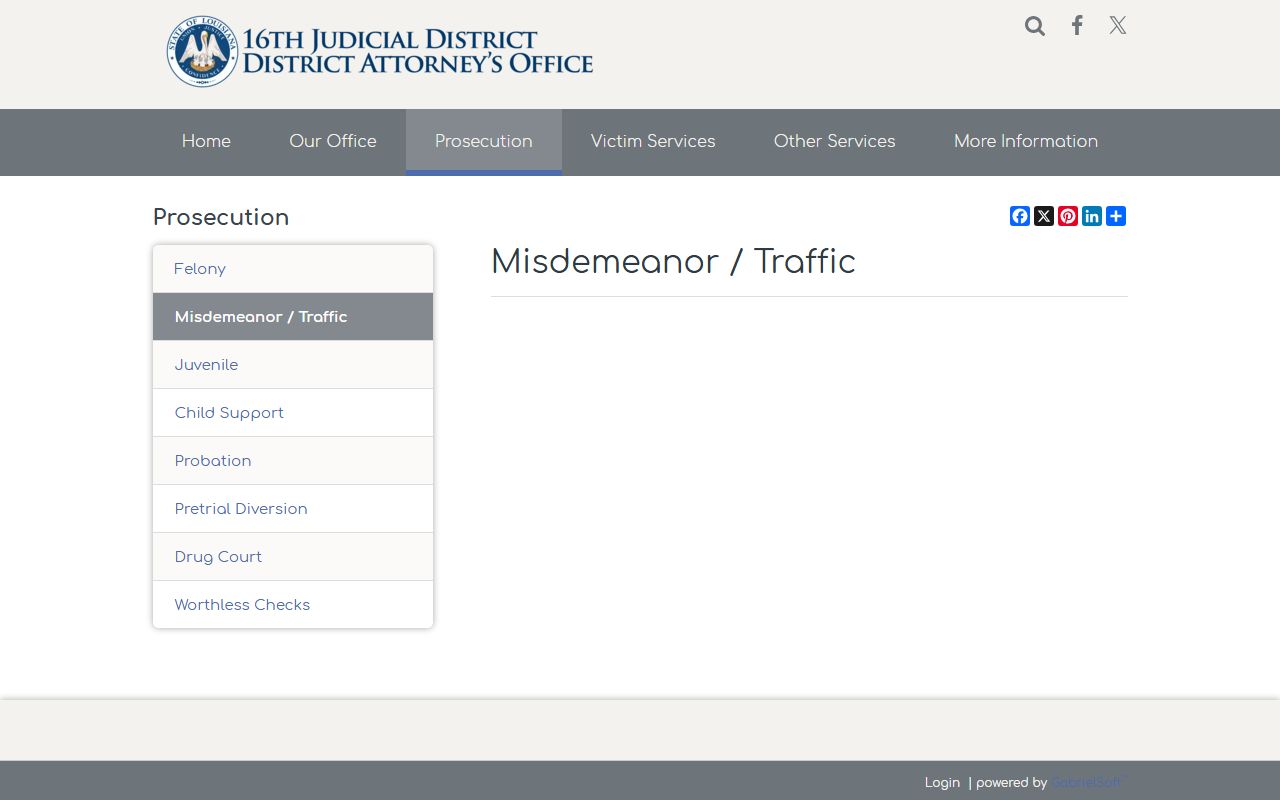
That prosecution context is useful when a misdemeanor or traffic-related offense moves from citation or arrest into a court case.
Iberia Parish Criminal Record Fields
A criminal court record can show both event history and final outcome. The research inventory identifies expected fields such as case number, court division, judge, party names, filing dates, event dates, filed documents, financial fields, service data, and disposition. In criminal matters, the parties are often the State and the defendant. The important reading point is that a filed charge, a plea, a disposition, and a sentence are different parts of the same court record.
| Field | What It Shows |
|---|---|
| Case or docket number | The Clerk-assigned identifier used for search, calls, docket lookup, and copies. |
| Defendant | The person accused in the filed criminal case. |
| Court and division | The 16th JDC division, judge, or lower court tied to the case. |
| Charges | The filed accusation, which may later be amended, reduced, dismissed, or resolved by plea or trial. |
| Plea | The defendant's formal answer, such as guilty, not guilty, or another plea accepted by the court. |
| Disposition | The outcome of the charge or case, including dismissal, conviction, acquittal, or other result. |
| Sentence | The punishment imposed after conviction, such as jail, probation, fines, restitution, costs, or conditions. |
| Subpoenas and service | Witness commands, service returns, and proof that required notices were issued or attempted. |
The 16th Judicial District Public Defender is the official defense resource documented for eligible defendants in the district.

Public defender involvement may appear through court appointments, motions, hearing notices, or related docket entries.
Iberia Parish Charges and Convictions
A charge is an accusation. A conviction is a guilty plea or finding of guilt. Iberia Parish criminal court records may show both, and they should not be read as the same event. A case can show charges that were dismissed, amended, reduced, diverted, or resolved in a way that does not produce a conviction. The final disposition and sentence are the parts of the court file that explain the legal outcome.
| Charge | Conviction | |
|---|---|---|
| Meaning | A formal accusation filed or presented in the case. | A guilty plea or finding of guilt accepted by the court. |
| Where it appears | Charging document, docket entry, arraignment, or amended charge line. | Disposition, judgment, plea minutes, sentence, and final order. |
| Can change | Yes, charges may be amended, reduced, or dismissed. | The conviction status changes only through lawful court action. |
| How to verify | Read the docket and charging document. | Read the disposition and sentencing record. |
Read Dispositions and Sentences
Disposition means the outcome of the case or charge. In an Iberia Parish criminal court record, it may show dismissed, guilty, not guilty, conviction, sentence, probation, expunged, or sealed if that status is visible. Sentence means the punishment imposed after conviction. It can include jail, probation, fines, costs, restitution, conditions, or other court-ordered terms. A docket may point to the sentence date, while the full case file or minute entry may be needed to read the exact terms.
Subpoena entries can also be important. Research from the Clerk's fee material notes that local subpoenas should be filed 10 days before court and out-of-town subpoenas 30 days before court. In misdemeanor cases, the Clerk can issue up to six subpoenas for free, while felony cases allow up to 12 for free. Officer, civilian, and out-of-parish subpoena fees may apply under the Clerk's listed rules.
Note: A charge line alone does not prove a conviction; read the disposition and sentence before drawing conclusions.
Iberia Parish Sealed and Expunged Records
Sealed and expunged criminal records are restricted from ordinary public access. The Iberia Parish Clerk warns that expungement forms are legal forms, must be printed on legal-size paper, and all fees are nonrefundable. The Clerk cannot give legal advice and recommends contacting an attorney. Louisiana State Police explains that court-ordered expungements require criminal-history record changes and remove arrest or conviction records from public access except as Louisiana law provides.
| Sealed | Expunged | |
|---|---|---|
| Public visibility | Restricted by court order, rule, or statute. | Removed from ordinary public access after court order and agency processing. |
| Record existence | The file may still exist but is not open to the general public. | State Police notes expungement does not always mean every agency record is destroyed. |
| How to seek access | Ask the Clerk or court about the required order or authority. | Use the Clerk forms and state expungement process if eligible. |
| Common limits | Juvenile, protected, mental-health, or court-restricted material. | Eligibility limits apply, and some arrests or convictions are not eligible. |
The Louisiana State Police expungement page explains state-level processing after a court order affects criminal history access.
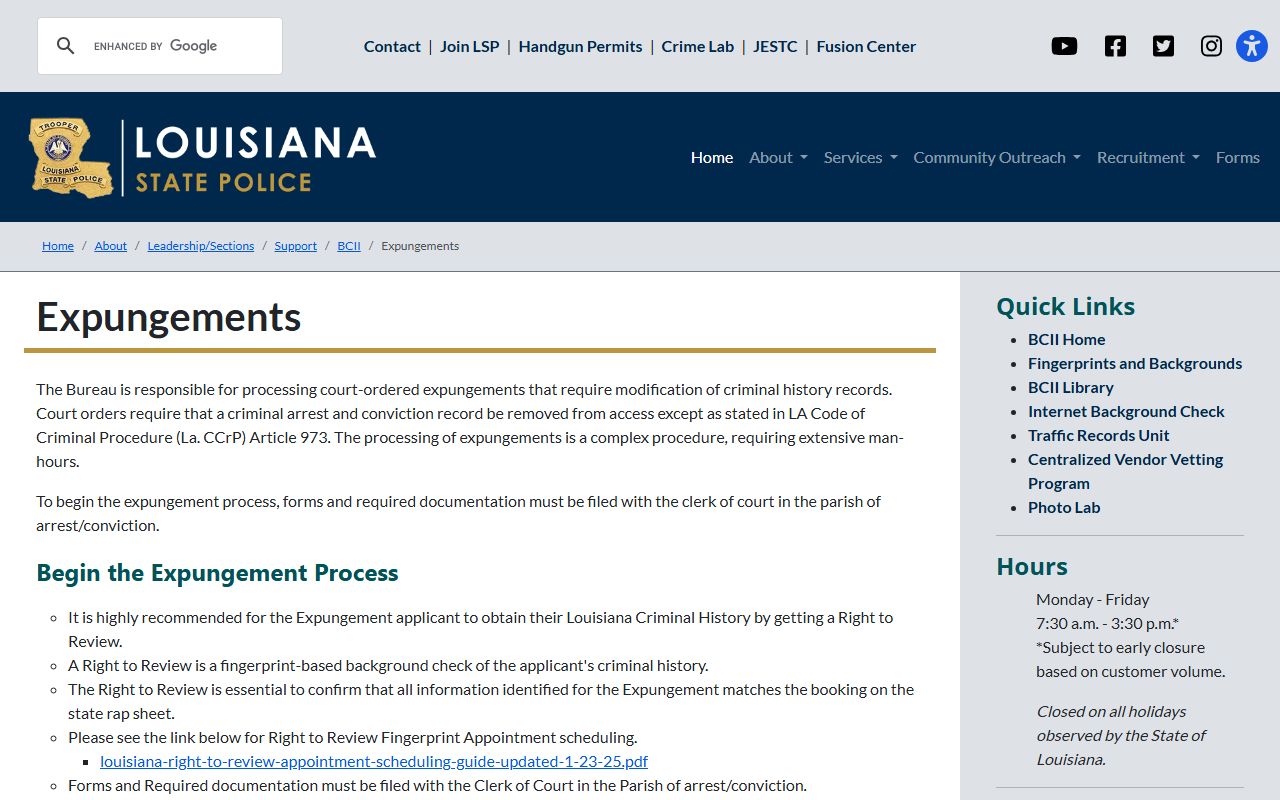
State processing is separate from finding the court case, so both the Clerk and the state criminal-history process may be involved.
Public Access to Iberia Parish Criminal Records
Louisiana public-records rules support access to public records unless a specific statute, court rule, or court order restricts the file. La. R.S. 44:1 defines public records and public bodies, while Title 44 provisions address inspection and copying. Criminal and law-enforcement records have special limits, especially for active investigations, juvenile matters, sealed warrants, expunged records, and protected personal information. Court records also depend on the court's own access rules.
In practice, Iberia Parish criminal court records are accessed through the Clerk of Court, Clerk Connect, docket lookup, or an in-person copy request. The Clerk's official background check is narrower than a statewide or FCRA consumer report. It covers charges only in Iberia Parish, does not include New Iberia city charges or other parishes, requires a copy of the subject's driver's license, and has a listed $20 fee. That local background check should not be treated as a full criminal-history report.
Key access points: Clerk Connect covers criminal records from 11/30/1959 forward; certified copies and restricted-file questions go through the Clerk.
Iberia Parish DA and Defense Roles
The District Attorney decides many prosecution paths after arrest, including whether charges are accepted, amended, diverted, dismissed, or prosecuted. The 16th Judicial District Attorney site includes felony, misdemeanor and traffic, juvenile, child support, probation, pretrial diversion, drug court, worthless checks, victim services, forms, and public records request navigation. The Iberia contact listed in the research is 300 Iberia Street, Suite 200, New Iberia, phone 337-369-4420.
The Public Defender represents eligible defendants. Research lists the official 16th Judicial District Public Defender site and an Iberia contact from the Clerk page at 301 E. St. Peter Street, Suite 101, New Iberia, phone 337-365-4006. A separate nCourt public defender application fee page also listed 110 W Washington St, New Iberia, with the same phone, so the current address should be verified through IDB16 before visiting.
Restricted Iberia Parish Criminal Files
Some criminal record details are not public even when a docket exists. Juvenile delinquency records, child-related matters, sealed cases, expunged cases, mental-health information, protected addresses, Social Security numbers, financial account numbers, medical details, and minor names may be withheld or redacted. Active investigative records can also be restricted under Louisiana public-records limits for law-enforcement or prosecutive material. When a case is restricted, a public search may return little or nothing.
The Iberia Parish Clerk expungement page is the local starting point for expungement forms and warnings.
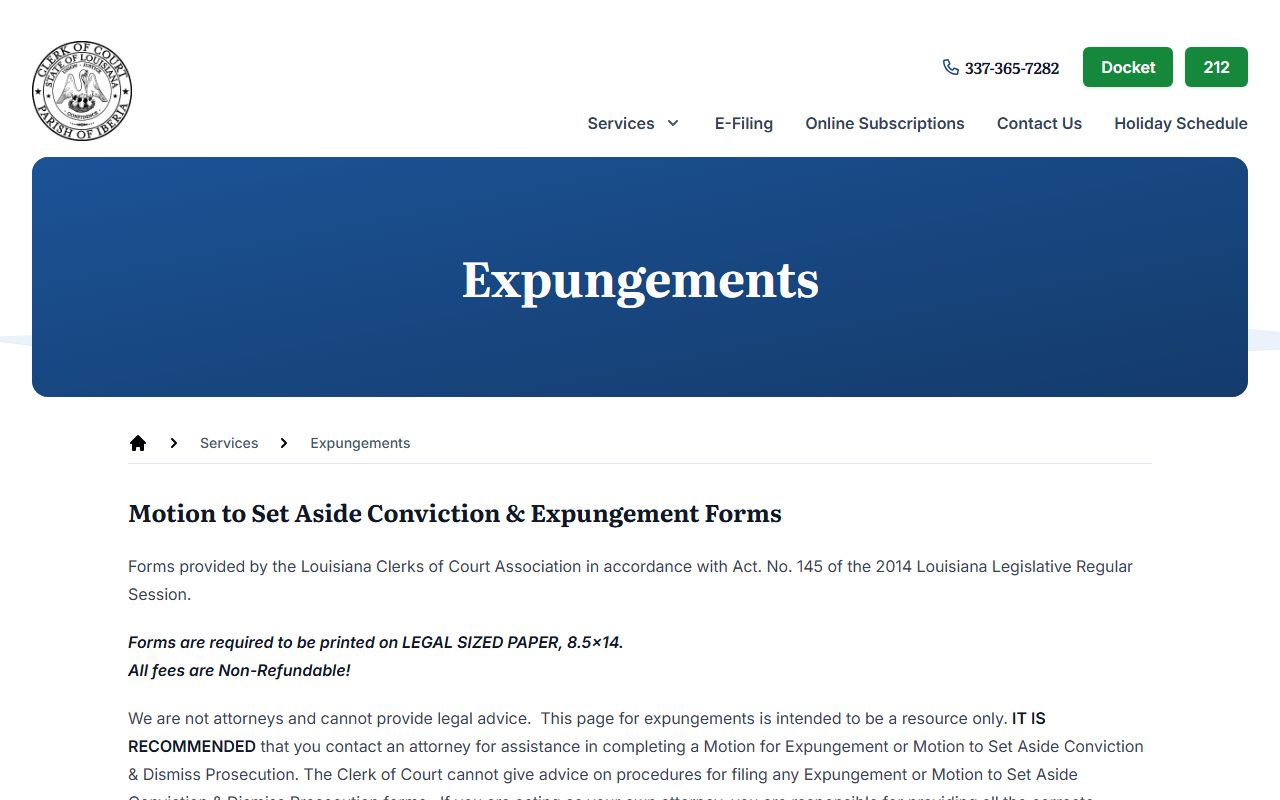
Use the Clerk's expungement page for form categories and local cautions, then verify legal eligibility before filing.